
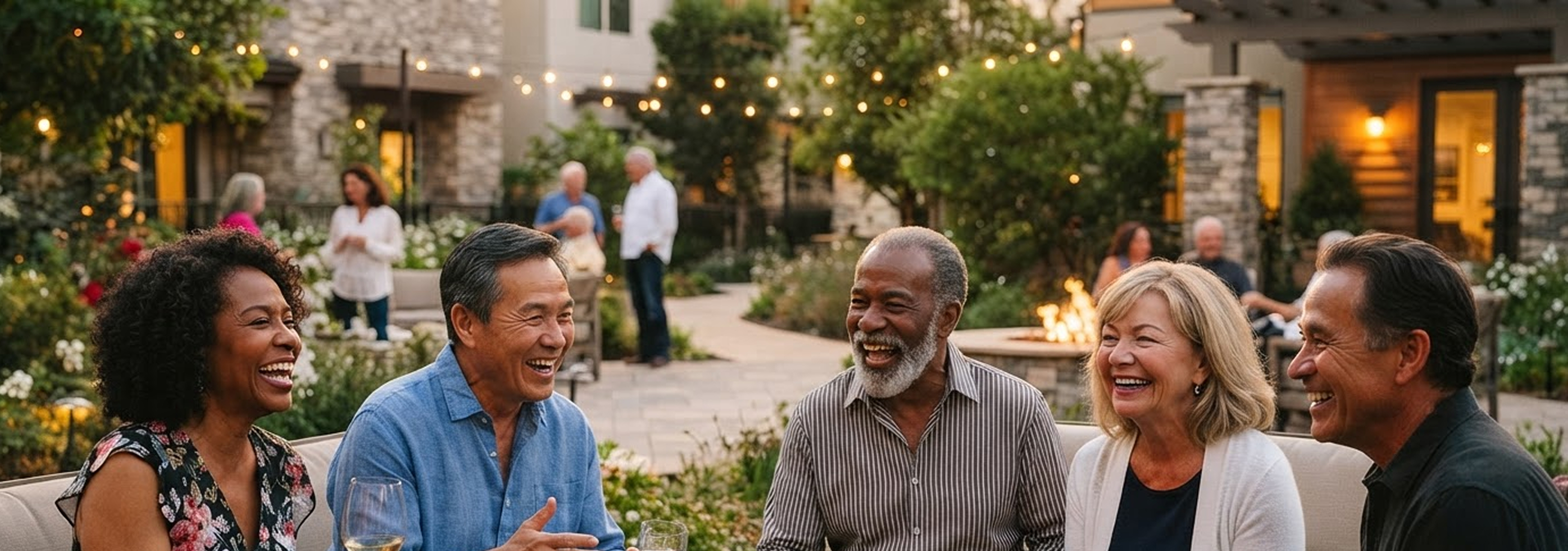
Housing · Active Adult Communities
Build a Great Neighborhood. Then Own It for the Long Run.
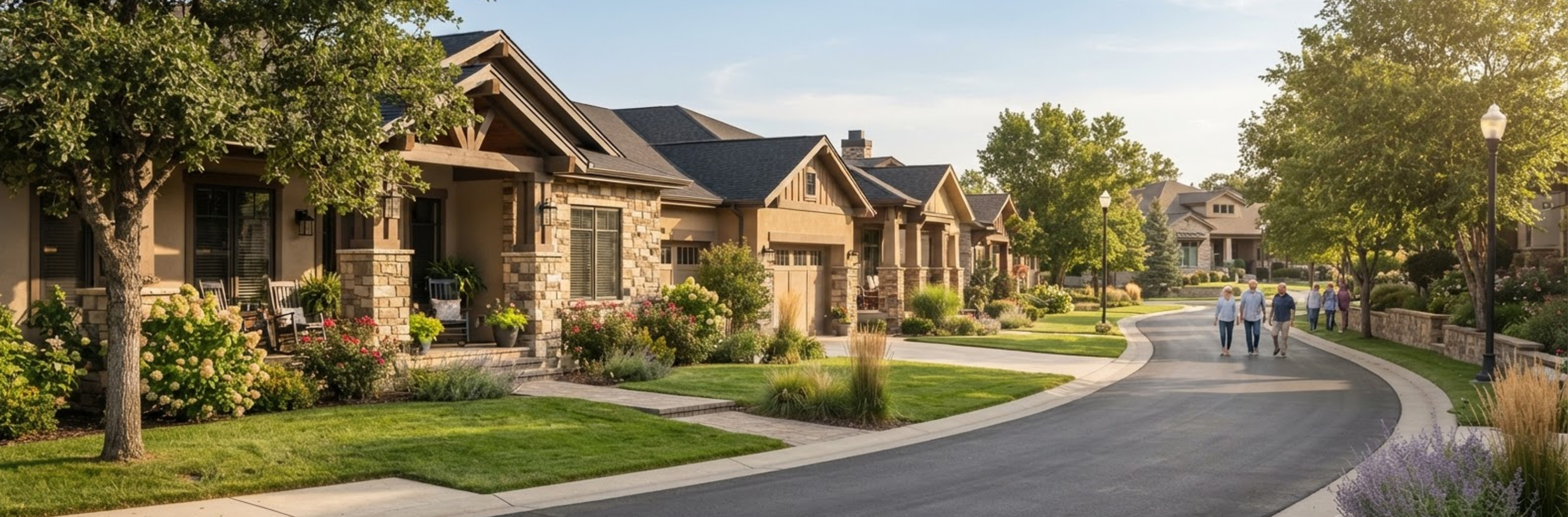
We build rental communities for people aged 55 and over who want the space, privacy and pride of a real home — without the mowing, repairs and upkeep that come with owning one. We develop each community, fill it with residents, place it in a debt-free trust for long-term investors, and stay on to look after it.
This Is Not Senior Housing — And That Difference Is the Whole Point.
“Active adult” is often confused with assisted living or retirement homes. It is something quite different. These are ordinary, well-designed homes for independent people who simply happen to be 55 or older. Understanding that distinction is the key to understanding why we invest in them.
| What It Is | What It Is Not |
|---|---|
| Single-level homes and duplexes built for people aged 55 and over | Not assisted living, memory care or a nursing home |
| Amenities designed for an active, independent life — a pool, fitness center, pickleball, trails | No nurses, care staff or medical services on site |
| Standard rental leases and running costs, like any quality rental community | No healthcare licenses to hold, and no Medicare or insurance billing |
| Residents who tend to stay for years, often after selling a family home | Not competing head-on with every new apartment building nearby |
| Growing suburbs close to shopping, healthcare and family | Not a care business dressed up as real estate |
Because there is no care provided, there are no healthcare licenses, no dependence on government reimbursement and none of the regulatory risk that makes traditional senior housing difficult to own. Running costs look like those of a well-managed rental community — while residents typically stay much longer than apartment renters do.
Tomorrow's Residents Are Already Here.
Unlike most real estate, the demand for active adult housing doesn't depend on predicting the economy. It depends on the calendar. The people who will want to live in these communities over the next decade are already in their fifties and sixties today — and very few communities like ours are being built for them.
61.2M
Americans aged 65+
Up 13% since 2020.
0.4%
Growth in active adult housing
A record low, with construction at its lowest level since 2012.
95.7%
Occupancy
At established active adult communities nationwide.
*U.S. Census Bureau; NIC MAP, Q1 2026. These figures describe the national market, not RREI's results.
There is one honest caveat. Demand this certain still doesn't arrive on a fixed timetable. Most residents sell a house before they move in, so when the housing market slows, new residents arrive more slowly too. The demand itself is reliable; its timing is not. That timing risk sits in the construction and leasing phase — before the community ever enters a trust.
215 Homes on 54 Acres in One of Chicago's Fastest-Growing Suburbs.
Americana is the first community in our active adult program, and the model for those that follow.
215
Homes
124 attached ranch duplexes and 91 detached ranch homes, in six floor plans.
4.0
Homes per acre
About half as dense as a typical rental community, leaving room for real green space.
6,000
Sq ft clubhouse
The heart of the community, set between its two neighborhoods.
*RREI development proforma, July 2026; Tracy Cross & Associates, June 2026. Illustrative; subject to final design.
What It Will Actually Look Like.
Single-story homes, wide setbacks, and an amenity core at the center of the plan.
-
The community from above — 215 homes on 53.9 acres -
The 6,000 sq ft clubhouse and amenity core -
Attached ranch duplexes — 124 of them -
Detached ranch homes on 50-foot lots
Source: Active Adult deck, slide 5. Illustrative renderings; subject to final design.
The Homes
Every home is on a single level, with an attached two-car garage, and is maintenance-free by design — residents don't mow, shovel or fix the roof. The community is split into two neighborhoods. The "Duet" neighborhood has 124 attached ranch duplexes of roughly 1,263 to 1,522 square feet, set on 65-foot lots. The "Solo" neighborhood has 91 detached homes of roughly 1,486 to 1,897 square feet on 50-foot lots, for residents who want a house entirely their own. Granite or quartz countertops, luxury plank flooring and smart-home technology come standard in every home.
Life at Americana
The clubhouse is designed to be where the community comes together. It includes a resort-style pool and sun deck, a fitness center and yoga studio, a golf simulator and putting green, two pickleball courts, a café and demonstration kitchen, card and billiards rooms, and coworking space for residents who still work. Outside there are walking trails, a dog park, a community garden, grilling stations — and a playground for when the grandchildren visit.
Two Neighborhoods Either Side of the Clubhouse.
53.9 acres, four homes to the acre, with the amenity core in the middle of both.
resort pool + deck
2 pickleball courts
putting green · dog park
- ✓ Solo neighborhood — 91 detached homes on 50-foot lots West of the amenity core, backing onto the landscape buffer along Renwick Road.
- ✓ Duet neighborhood — 124 attached duplexes on 65-ft lots East of the core, fronting IL-59 behind a five-foot undulating berm.
The Location
Americana sits in the heart of Chicago's southwest growth corridor — about a mile from downtown Plainfield's restaurants and shops, under two miles from Interstate 55, six miles from Naperville and 35 miles from downtown Chicago. Plainfield itself has more than doubled in size since 2000, to about 50,500 people, and its median household income of about $147,500 is roughly half again the Chicago-area median. Every school in Plainfield is rated Commendable or Exemplary by the state. That is what drew young families to the area — and grandparents tend to follow their grandchildren.
- Aurora
- Oswego
- Downtown Plainfield
- Naperville
- Bolingbrook
- Romeoville
- Lockport
- Joliet
- Shorewood
- Downtown Plainfield — 1 mile Coffee houses, restaurants and specialty shops. Walkable, not a strip mall.
- Interstate 55 — under 2 miles The region's primary southwest corridor, and the route back into the city.
- Naperville — 6 miles Shares Plainfield's demographic profile, and feeds the same catchment.
- Redwood–Lockport — 9 miles The nearest comparable community. Fully occupied, with a waiting list.
- Aurora, Oswego, Yorkville — 9 to 13 miles Spillover from all three is excluded from the demand model entirely.
Schematic — distances approximate; not a geographic map.
The Competition
An independent market study found no comparable community — lower-density, age-restricted rental housing for people over 55 — either open or planned anywhere in Americana's market area. The same study estimated demand for about 705 homes over five years from within that area alone, without counting anyone moving in from nearby Aurora, Naperville, Oswego or Yorkville. The closest comparable community, nine miles away, is fully occupied and has a waiting list.
Tracy Cross & Associates market and absorption study, June 2026; U.S. Census Bureau. Community details are illustrative and subject to final design and approvals.
About Three Years from an Empty Field to a Full Community.
Leasing begins roughly a year before the first homes are finished, so that by the time residents can move in, there is already a waiting list. Here are the main milestones.
Indicative, per Tracy Cross & Associates absorption study (June 2026). Pre-leasing start approximate. Actual timing set in offering documents.
-
Month 0
Construction Begins
Building starts. Pre-leasing opens about a year before the first homes are ready.
-
Month 17
First Residents Move In
The first homes are finished and residents move in from the waiting list.
-
Month 28
All Homes Finished
All 215 homes are complete, and leasing continues through the remaining homes.
-
Month 34
Community Fully Leased
About 95% of homes are rented — the point at which we consider the community stabilized.
-
Month 36
Ready for the Trust
The development investment is completed and the community can move into a DST.
Timing is indicative and based on the June 2026 market and absorption study. Actual timing depends on construction, approvals and market conditions, and will be set out in the offering documents.
Build It. Place It in a Trust. Offer the Fund. Hold for the Long Term.
-
01
Build
We develop the community using a standard construction loan covering about 75% of the cost, then lease it to about 95% occupancy.
-
02
Place It in a Trust
Once the community is full, it moves into a debt-free DST. The money investors pay for their shares repays the construction loan in full and returns the development investors' capital.
-
03
Offer a Move into the Fund
When the trust reaches the end of its term, its investors can choose to exchange their shares for units in RREI's active adult REIT, or take cash.
-
04
Hold for the Long Term
The REIT can own communities indefinitely, with RREI continuing to manage them.
One rule shapes the whole timeline: a community cannot go into a trust while it is still being built or leased up. A DST can never raise more money or borrow again once it's formed, so it couldn't pay for construction or carry a half-empty community. That rule comes from the tax law, and we don't bend it.
Three Stages, Three Very Different Investments.
It's important to understand that investing during development, investing in the trust and investing in the fund are genuinely different investments, each with its own risks and rewards. The table below shows how they compare.
| Investing in Development | Investing in the Trust | Investing in the Fund | |
|---|---|---|---|
| When You Invest | Before Construction Begins | Around Year Three, Once the Community is Full | At the End of the Trust's Term |
| What You Own | A share of the development project | A share of the finished, fully leased community | Units in a fund that owns several communities |
| The Main Risk | Building and leasing the community | How this one community performs | How the whole portfolio performs |
| How You're Paid | A gain once the development is completed | Regular distributions from rent | Ongoing distributions, with limited withdrawals |
| Tax | Gain is taxable; can't be used for a 1031 exchange | Structured to qualify for a 1031 exchange | Tax deferred until you convert or withdraw units |
| How Long | About three years | Set for each offering | As long as you choose |
The returns targeted during development and the income paid by the trust come from different investments with different levels of risk. We always present them separately and never combine them.
Three Partners, Each Doing What They Do Best.
The Builder
An experienced Chicago-area homebuilder builds the homes.
RREI
We arrange the financing, sponsor the trust and the fund, lease the entire community from the trust as master tenant, and manage it as an investment. That means re-leasing homes as residents come and go is our responsibility — never the trust's.
A Professional Operator
A national, institutional-quality apartment management company handles the day-to-day running of the community and the relationship with residents, working under RREI's direction.
RREI invests its own money in the development alongside our investors, as general partner. We're invested in the outcome, not just paid to deliver it.
What Could Go Wrong — And How We've Planned for It.
Every development carries risk. Here are the ones we think matter most, and what we've done about each. None of our answers is “it won't happen.”
Our plan assumes a lower sale price than comparable communities have actually achieved, and the construction loan is sized at about 75% of cost.
The site is suburban and uncomplicated, we already control the land, and the builder has built this style of home many times.
The market study found nothing comparable open or planned in the area over its 24-month window.
Americana is age-restricted, offers detached homes the nearest competitor doesn't, and has a full clubhouse and amenities.
We work with care-navigation and referral partners, but we will never provide healthcare on site — doing so would change what the community is.
Most residents sell a home before moving in, so a slower housing market could slow leasing and lengthen the timeline.
Americana Is Our First Community, Not Our Last.
We plan to build a series of active adult communities, each typically with 190 to 240 homes and a total cost of $75 million to $100 million, sized to suit its local market. Every community follows the same approach — the same careful test of local demand, the same building partners and the same structure — so each one after Americana starts from experience rather than from scratch.
Projections and program goals reflect RREI's own assumptions and are not guarantees. Development investments carry construction, leasing, market and financing risks, including the possible loss of your investment. Offered only to verified accredited investors, by means of offering documents.